Exhibitions 1993

«Overview
  

This is where Teitelbaum lived…”. A walk through time and space in Jewish Vienna

November 21, 2003 to May 15, 1994
 
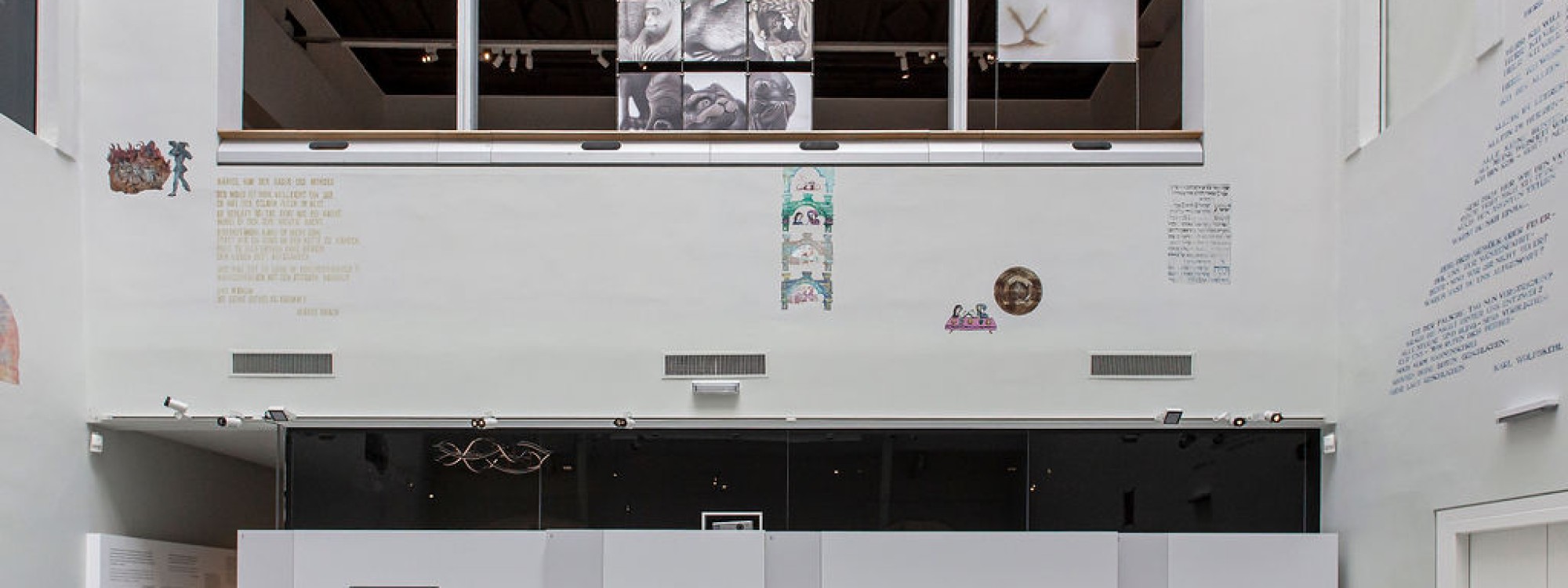
This opening exhibition of the Museum presents a pointed and compressed history of Jewish Vienna: a walk-on city map of 1931 forms the point of departure for a presentation of the most diverse elements of Jewish Vienna’s cultural history. This city map contains excerpts from old city maps that document both specific eras of history and specific subjects: while the overall map presents Vienna in general, each of these excerpts deals with a particular facet of the history and culture of Viennese Jewry. Selected objects - partly from the ample collections of the Museum - will additionally illustrate these aspects. Explanatory historical texts form a link between the presented objects and themes.
Yet this presentation does not aim at a complete picture of the history of Viennese Jewry; rather, the aspects presented are to document the numerous impulses that the Jews of Vienna have contributed to the city’s culture and intellectual life. This also emphasizes the great potential lost to emigration and holocaust. The name “Teitelbaum” aptly underlines this fact: while the Viennese directory of 1938 gave sixteen addresses for this name, the modern telephone directory of Vienna (1993/94 edition) has no entry for “Teitelbaum”…
 
Curator: Felicitas Heimann-Jelinek
 
Palais Eskeles
Dorotheergasse 11
1010 Vienna
  

Song of Songs. Paintings by Heinz Mack in connection with an interpretation of the text of the Song of Songs by Manfred Hausmann

November 21, 1993 to February 13, 1994
 
The “Song of Solomon”, or “Song of Songs”, is world literature. This collection of popular love and wedding lyrics, accepted into the Biblical canon, is popular poetry in the highest sense of the word. The Song of Songs is not a uniform work but consists of songs created at different times in ancient Israel and sung at marriage ceremonies. Their sub¬jects are pain, happiness, faithfulness, yearning and deeply felt passion. The texts have been interpreted in different ways, depending on the various periods: while early interpretations were based on the love of God, human love is their keystone today. Yet the Song of Songs was not only variously interpreted but also translated many times, e.g. by Johann Wolfgang von Goethe, Max Brod, Martin Buber, Manfred Hausmann…
Heinz Mack, the German painter and sculptor, has based his visual interpretation of the Song of Songs on the version prepared by the poet Manfred Hausmann (1898-1986): poetry celebrating the romanticism of vagabond life and a melancholy experience of nature. In his paintings, Mack, co-founder of the avantgarde artists’ movement ZERO, traces the rhythm and melody of Hausmann’s language, which he tries to transpose visually into abstract art. His paintings refer to the individual verses and sequences of words that have inspired him. In this, Mack attempts to visually convey those emotions and impressions which the poet cannot express by language.
 
Curator: Karl Albrecht-Weinberger
 
Palais Eskeles
Dorotheergasse 11
1010 Vienna
  

The Freudians. Photographies of the 13th International Conference of Psychoanalysis held at Lucerne in 1934 by Nachum T. Gidal

November 21, 1993 to March 5, 1994
 
The photographies of Nachum T. Gidal are an excellent example of early photo-journalism when this discipline of photography searched for new ways of expression in between portrait and art photography. Yet Gidal’s photographies, taken at the 13th International Conference of Psychoanalysis held at Lucerne from 26 to 31 August, 1934, are also highly significant for contemporary historians since the conference was characterized by two important events: on the one hand, it took place against a background of profound scientific dispute within the psychoanalytical movement; on the other hand, the National Socialists - who took a hostile view of psychoanalysis in general and its Jewish representatives in particular - had come to power the year before.
Our knowledge of the historical background endows Gidal’s photographies with a special significance. He shows us a peaceful academic world of well-read and cultivated people in scientific discourse - people that modern observers will easily identify as leading representatives of psychoanalysis: Anna Freud, Melanie Klein, Ernest Jones, Jekels (a member of Freud’s Saturday round of tarock - a popular card game), Maurits Katan, Otto Fenichel, Karl Landauer, Max Eitingon and others. With the help of his camera, Gidal succeeds in characterizing the protagonists, in making visible both their relations and their scientific and human differences.
And yet - these pictures give no indication of the fact that while the Institute for Psychoanalysis still existed in Berlin, all Jewish members were already excluded from scientific work, or that in Fascist Austria Federal Chancellor Dollfuss had been killed by National Socialists only a few weeks before, or that psychoanalysts could then only work under police surveillance. The exhibition places the photographs in this historical and political context and uses the portraits of individual personalities to reveal an important moment in the history of psychoanalysis by applying the methods of political and scientific historical research.
 
Curator: Dr. Elisabeth Brainin
 
Palais Eskeles
Dorotheergasse 11
1010 Vienna
  

Wien IX., Berggasse 19. Photographies of the apartment of Sigmund Freud before his emigration by Edmund Engelman

November 18, 1993 to March 5, 1994
 
It was in the spring of 1938: “On a wet March morning in 1938”, a few weeks after the annexion of Austria by Nazi Germany and shortly before Sigmund Freud, then over eighty years old, was forced to emigrate, a young photographer visited the apartment and practice of the founder of psychoanalysis in Berggasse 19. His name was Edmund Engelman. Engelman, born in Vienna in 1907, worked for two days in Berggasse 19 and thus also met Sigmund Freud, who let himself be photographed; Freud’s wife Martha and his daughter Anna likewise consented to have their portraits taken. Inbetween, Engelman documented his impressions of Freud’s apartment and practice with the camera: the collection of more than 2,000 antiques, the library, the numerous awards and decorations, the therapy room and the famous couch. He was the last to see Freud’s home in its original condition: on 4 June, 1938, Freud left Vienna. His household was scattered: partly sold and left behind, partly taken along into his exile, it became impossible to reunite the fragments after the Second World War.
Engelman’s photographic documentation is unique in conveying to us a complete picture of Freud’s life and work, showing him one last time in his familiar surroundings, the apartment whose rooms and furniture were to become symbols of the intellectual history of 20th century Europe. Engelman emigrated shortly afterwards. After the Second World War, his photographs provided valuable help in reconstructing Freud’s household in Vienna. However, it took some time until the Sigmund Freud Museum was opened in the presence of Anna Freud in 1971.
 
Curator: Bernhard Purin
 
Palais Eskeles
Dorotheergasse 11
1010 Vienna