Visiting Beer-Hofmann. An Exhibition on Jewish Vienna at the Turn of the Century
February 10 to April 11, 1999
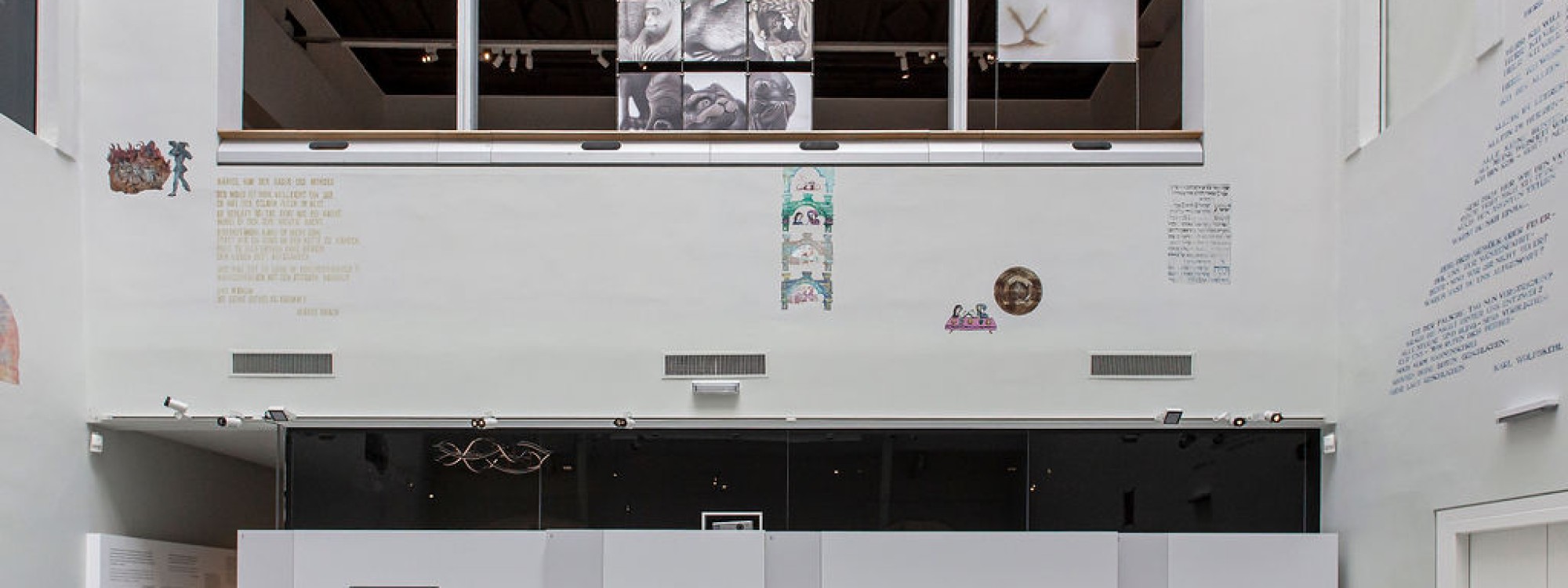
“Visiting Beer-Hofmann” is an exhibition on Jewish Vienna at the Turn of the Century. The presentation is organized as a soiree at the home of Richard Beer-Hofmann, one of the most influential writers of that period. The invited guests are Viennese intellectuals, mostly of Jewish origin, playing a major part in Vienna’s cultural life. Each of the guests brings a present (paintings, manuscripts, photos, furniture etc.). By showing these objects, a network of personal, social, and political connections is created, thus describing the historical background as well as the tensions, disputes and conflicts of that period of time.
A special concern of the exhibition “Visiting Beer-Hofmann” has been to expose the easy to sell product of “Viennese Fin-de-siècle” as well as the exhibition itself as being what they really are: simply constructs of our view of history. To provide a permanent pointer to this construct, the exhibition is based on a fiction: Richard Beer-Hofmann invites guests to an evening at his house, and each guest, as is customary, brings a gift. This idea is not without foundation since the Beer-Hofmann house was in fact one of the centers where some of the intellectual elite of the time gathered. Not only historically authenticated guests were selected to illustrate the incredibly dense and so decisive cultural fabric of relationships in Vienna between the end of the nineteenth and the first third of the twentieth century, but also persons who might have been visitors to the Beer-Hofmanns’ home. On the other hand, some acutal friends and acquaintences of his were not considered due to a lack of relevant objects, and the time of the evening chosen is as obviously fictitious as the event itself.
Accepting this fiction, the visitor should allow himself, up to a certain degree, to become the guest. That way he is not simply be a voyeuristic and consuming observer of the visits to Beer-Hofmann, but is a visitor in a double sense. To this end, he should distinguish between Beer-Hoffmann’s inner world, represented through a mainly genuine ambience, and the outer world of the guests, represented through their gifts. Each guest brings an individual gift that focuses on a specific topic.
Although Richard Beer-Hofmann might have been pleased, astounded, or even annoyed about the variety and pointedness of these gifts, he was also forced to consider his era, friends and colleagues, art, modernism, nationalism and anti-Semitism, Judaism and Zionism at the time of Fin-de-siècle Vienna. As he could not limit his view to aesthetic appreciation of the aura, sensuousness, and sometimes humor of these presents, so should one as a visitor to the exhibition and to the evening at Beer-Hofmanns’ itself also consider the deeper significance behind these gifts.
“Visiting Beer-Hofmann. An Exhibition on Jewish Vienna at the Turn of the Century” is a joint exhibition of the Jewish museums of Amsterdam and Vienna.
Curator: Felicitas Heimann-Jelinek
Palais Eskeles
Dorotheergasse 11
1010 Vienna
Viennese Views (Wiener Einstellungen). Photographs by Lisl Ponger
February 10 to May 2, 1999
“Viennese Views” (Wiener Einstellungen) is an exhibition about the history of Jewish Vienna. The photographer Lisl Ponger approached her material simply as documentaries. The main reason for this was that hardly anything has remained from the former Jewish Vienna. The few remaining vestiges of the past - if one discounts a few, questionable documents such as memorial plaques - can only be disclosed on a purely associative level. Lisl Ponger’s photos, in the final analysis, document something that doesn’t exist any more. But they do show what exists today at these historically significant locations. Each photo is controlled, as it were, by the viewer, who is forced to attempt to connect or at least correlate the non-visible with the visible, imagination with reality, and past with present. This photographic approach is supplemented by captions with explanatory texts. On the surface, the pictures show contemporary Vienna, but the captions, one’s own knowledge or maybe only one’s presentiments, bring the former Jewish Vienna to mind. Therefore, there will be two captions: under the picture, simply the name and address of the former building - e.g.: Vienna 2nd district, Zirkusgasse 2, Turkish Temple. Opposite the photo, one may read a contemporary description of the former historic location. The discrepancy between the photo of a new building or one that cannot be defined as ”Jewish,” and a description which contains an unmistakably Jewish past, may create an unpleasing tension in the viewer and challenge his understanding.
Curator: Lisl Ponger
Palais Eskeles
Dorotheergasse 11
1010 Vienna
Georg Chaimowicz
April 21 to June 6, 1999
The Jewish Museum Vienna is featuring a large-scale retrospective to commemorate the 70th birthday of the artist Georg Chaimowicz. This exhibition includes some 200 of his works, which consistently and indefatigably expose the fascist reality beneath society’s neo-bourgeois facade. At the same time Chaimowicz has never felt himself bound by the narrow limits of conventional anti-fascist graphic art nor does he sacrifice artistic form in any way to political content. This representative selection of an oeuvre that encompasses several thousand works gives a clear picture of the artist’s development.
Chaimowicz’s confrontation with neo-Nazism and anti-Semitism has exerted a major influence on his work since his return as a 20-year-old from Colombia in 1949. He has sought this confrontation with a tenacity that has even led to his legal prosecution. But whatever the courts might say, they have never been able to divert him from his protestation against the dangers of extreme right-wing and racist tendencies or his conviction that hate and persecution continue to smoulder under the surface, waiting to erupt again one day.
Chaimowicz work is cyclic and often features extended series of drawings over a period of many years in which grim and highly realistic portrayals of marching veterans, steel helmets, neo-Nazi thugs and biased judges are gradually stripped down to simple calligraphic forms. But just when it looks as if he is ready to take the last step from a plain white sheet to the imageless void, he will abruptly revert to a massive, black and menacing subject.
Curator: Reinhard Geir
Palais Eskeles
Dorotheergasse 11
1010 Vienna
”Murdering the Media” – Karl Kraus and The Torch (‘Die Fackel’)
June 23 to November 1, 1999
One of the most admired and controversial figures in literary history as well as the history of journalism is the focus of a major special exhibition at the Jewish Museum in Vienna: Karl Kraus (1874-1936). His journal “The Torch” (‘Die Fackel’) is today considered a unique phenomenon; for a quarter of a century Karl Kraus wrote this irregularly appearing publication practically on his own. The first issue of “The Torch”, which appeared in April 1899, already contained an apt formulation of Kraus’ ambition: ”The political program of this paper may well seem lacking; no resounding ‘What We Print,’ but rather an honest ‘What We Destroy’ is its guiding principle.”
In 1899 “The Torch” was something entirely new in the media landscape: a courageous journal which articulated its position provocatively, aggressively and satirically, and mercilessly took the other media of the age to task. The principal targets of its criticism were journalists and writers, corrupt officials, the nobility, and the wealthy bourgeoisie, whose mendacity, hypocrisy and lust for power Kraus closely observed and roundly denounced. The success of The Torch in its own time derived not least from its qualities as an independently oppositional journal. Today’s reader, however, is more likely to see a sharply focused image of Austrian society from the Danube Monarchy through the First Republic to the authoritarian regime of the Ständestaat.
The exhibition features the biography and literary working habits of Karl Kraus, the general as well as the specificially Jewish milieu of his era, and the complex process of composition and correction that characterized the publication of “The Torch”.
Curators: Heinz Lunzer, Victoria Lunzer-Talos, Marcus G. Patka
Palais Eskeles
Dorotheergasse 11
1010 Vienna
Traditional objects in modern form. Judaica from Bezalel
July 2 to September 5, 1999
The Bezalel School of Art, one of the most prominent art and design schools in Israel, was founded in Jerusalem in 1906 by the sculptor Boris Schatz. It has seen a number of developments over the years. Schatz’s aim was to create a national oriental style and to integrate local handicrafts. In 1935 Bauhaus artists who had emigrated from Germany took over the school and its master classes. The new directors embraced a strictly functionalist philosophy and emphasised the international aspect of art. Although Judaica were still made during this time, the main focus was on secular art. In the last few decades Bezalel has turned more towards modern European and American art. Through international projects and exhibitions, Bezalel’s teaching staff have managed since the mid-1980s to re-establish Bezalel’s deserved reputation for design of Judaica.
The exhibition at the Jewish Museum shows Jewish cult objects for use in the synagogue and the home, designed by teachers and students at Bezalel over the years, including works by renowned artists such as Boris Schwartz, Mordechai Ardon, Menachem Berman, Selig Segal, Moshe Zabari and Ari Ofir, as well as designs by promising young artists.
Aesthetically, Jewish ritual objects reflect their time, environment and owners. The Halakha – the set of laws governing religious observance – does not specify or forbid any particular materials or shapes for cult objects and torah ornamentation. They are not ends in themselves but serve to honour the torah and communicate the message and meaning of divine law.
The works of the Bezalel artists represent a successful combination of traditional Jewish handicraft and the challenges of modern design. Materials used include not only silver, bronze and stone but also more unusual matter such as concrete, Plexiglas and rubber. There is also a wide variety in terms of form. While some artists continue to use many traditional elements in their works, others seek a new, modern formal language.
Curators: Muli Ben Sasson, Gabriele Kohlbauer-Fritz
Palais Eskeles
Dorotheergasse 11
1010 Vienna
Carl König (1841 - 1915): A Neo-Baroque Metropolitan Architect in Otto Wagner’s Vienna
July 4 to September 12, 1999
Carl König is the architect par excellence of late-historicist neo-Baroque in Vienna. A native of this city, he was born as the son of a highly cultured art collector in 1841 - the same year as Otto Wagner, his later ”opposite number”. After studying construction engineering at the Vienna Polytechnic, König attended the master-class of the neo-Gothic architect Friedrich von Schmidt at the Academy of Fine Arts of Vienna.
König left two major legacies: as a professor at the Technical University of Vienna, whose rector he was in 1901/02, he taught innumerable architects from all provinces of the Austro-Hungarian empire. A list of their names includes such luminaries of Austrian 20th-century architecture as Josef Frank, Clemens Holzmeister, Friedrich Kiesler, and Oskar Strnad. As an architect, König designed several buildings which to this day are an integral part of Viennese architecture.
The œuvre of Carl König is characterized by a rare degree of stylistic homogeneity deeply rooted in the city’s architectural tradition. He designed synagogues for the Jewish communities of Vienna-Fuenfhaus and Reichenberg in Bohemia (today Liberec in the Czech Republic). Shortly before the turn of the century, he created several elegant residential buildings and premises in Vienna’s city center, such as the Philipp-Hof on Albertinaplatz, which was destroyed in the last days of the Second World War (the lot now houses the Monument against War and Fascism). Buildings like the Zierer-Hof on Neuer Markt or Palais Herberstein on Michaelerplatz bear witness to the Viennese neo-Baroque style championed by König and indeed served as models for countless neo-Baroque residential buildings all over Europe. Amongst those of König’s monumental designs still in existence, the most impressive examples include the Agricultural Produce Exchange on Taborstrasse, the annex to the Technical University building on Karlsplatz, and the House of Industry on Schwarzenbergplatz.
The exhibition at the Jewish Museum is the first comprehensive retrospective of the œuvre of this important Viennese architect. The show presents photographs, building plans, and documents relating to the life of Carl König.
Curator: Markus Kristan
Palais Eskeles
Dorotheergasse 11
1010 Vienna
him, too ..?? Oz Almog’s colorful Index Judaeorum - A Chronicle of a Cultural Obsession
September 22 to October 31, 1999
From May, 1998, to April, 1999, the Israeli-Austrian artist Oz Almog painted more than 400 oil portraits of Jewish personalities who, each in his or her own way, achieved fame or notoriety. Seen comprehensively, these faces form an artistic installation, a homage by the artist who intended to establish his own cultural network. This mosaic of personalities forms a bizarre world concept that traces the trials and errors of human ambition.
The personalities portrayed were selected by Oz Almog from a wide variety of social strata: European 20th-century artists, musicians and writers; representatives of science and research as well as Nobel prize winners; biblical, mythical and heroic figures and personalities; politicians and soldiers; entertainers; saints, freaks, gangsters and mass murderers. In alphabetical order, we find flamboyant heroes and anti-heroes whose one common denominator is their Jewish background. Nuclear scientist Albert Einstein rubs shoulders with philosopher Baruch Spinoza, sex symbol Hedy Lamarr with the poet Heinrich Heine, CNN talkmaster Larry King with chess world champion Gary Kasparov, film director Stanley Kubrick with mass murderer David Berkowitz, mafia boss Meyer Lansky with rock poet Bob Dylan, the canonized Carmelite nun Edith Stein with the Soviet bomber pilot Polina Gelman. There are also numerous local celebrities such as Karl Farkas, Vicky Baum, Franz Molnar, Emmerich Kalman ….
Curator: Oz Almog
Palais Eskeles
Dorotheergasse 11
1010 Vienna
From Samoa to the Isonzo. The photographer and travel journalist Alice Schalek
November 9, 1999 to January 30, 2000
The Jewish Museum Vienna shows an exhibition about a woman who is known solely from the pages of Karl Kraus´ The Last Days of Mankind. Kraus considered her primarily as a sensation-hunting war correspondent, marking her down as ”that Schalek”, the worst type of journalist imaginable. Yet the estate of her photography purchased a few years ago by the Austrian National Library allows us access to an entirely new side of Schalek, that of the ”professional tourist” and engaged observer of foreign countries and cultures, an aspect of her work that is considerably more apparent in her visual work than in her travel writings. While her reports reflect the views of a woman submerged in a Europe-centric, bourgeois mindset, her photos unveil a world that fascinates us today, one which now has either been largely falsified by mass tourism or indeed has been destroyed altogether.
Born into the wealthy Jewish bourgeoisie, Alice Schalek (1874 – 1956) – in part, perhaps, due to her origins - succeeded in making a mark in professions previously considered unthinkable for women: she was a journalist and photographer, war correspondent and travel writer, mountaineer, holder of scientific lectures and author. She was given the chance of travelling round the world on several occasions and on these trips took some 6.000 photographs. It was during the preparations for the Karl Kraus exhibition at the Jewish Museum Vienna that the suggestion was first made to exhibit Alice Schalek´s photographs. The decision to do so was spontaneously taken by those responsible in view of the high historical value of Schalek´s photographic work, and made possible due to the generous support of the Picture Archives of the Austrian National Library.
Curators: Elke Krasny, Christian Rapp, Nadia Rapp-Wimberger, Marcus G. Patka
Palais Eskeles
Dorotheergasse 11
1010 Vienna
Eden • Zion • Utopia. The history of the future in Judaism
November 24, 1999 to February 20, 2000
The Jewish Museum Vienna is presenting an exhibition on a subject of central significance in human thought – the future. Fears, hopes, visions, ideas about time and the past come to the surface as momentous dates approach or in times of political uncertainty. Strategies for dealing with the problems range from planning utopias to fatalism. Religion and art are particularly sensitive indicators at such times. The exhibition at the Jewish Museum presents historical objects, works of art and audiovisual media that encourage visitors to take a closer look at strategies devised by mankind to deal with the future.
What is really behind our hopes, fears, prophesies, desires, yearnings, plans and actions? Since earliest times mankind has developed numerous strategies in its attempt to plan for the future: it has invented calendars to better understand annual cycles; it has contemplated life and death; it has had prophets to predict the future; and it has elaborated social or territorial concepts for a better life. Political Zionism and religious messianism are probably the most well-known Jewish strategies for the future, but by no means the only ones. Mankind’s desire to shape its future can also be seen both in everyday objects and in works of art.
George Segal’s installation The Expulsion from Paradise starts off the exhibition at the very moment man has to face the future for the first time. The exhibition continues with Avraham Ofek’s sculpture The Bird of Choice and examines how 20th century painters have depicted prophets and others in contact with the future. Other parts of the exhibition are devoted to the annual cycle and life and death, messianism, and plans for utopian Jewish states. Exhibits showing how mankind has come to terms with the future include both everyday items and works of art: the oldest Hebrew calendar, a Zionist publicity film from the 1930s, photographs of Birobidjan, the Jewish Soviet utopia, and an Israeli land recovery project using artificial islands.
Curator: Werner Hanak
Palais Eskeles
Dorotheergasse 11
1010 Vienna