Princess Shabbat
February 15 to May 26, 2002
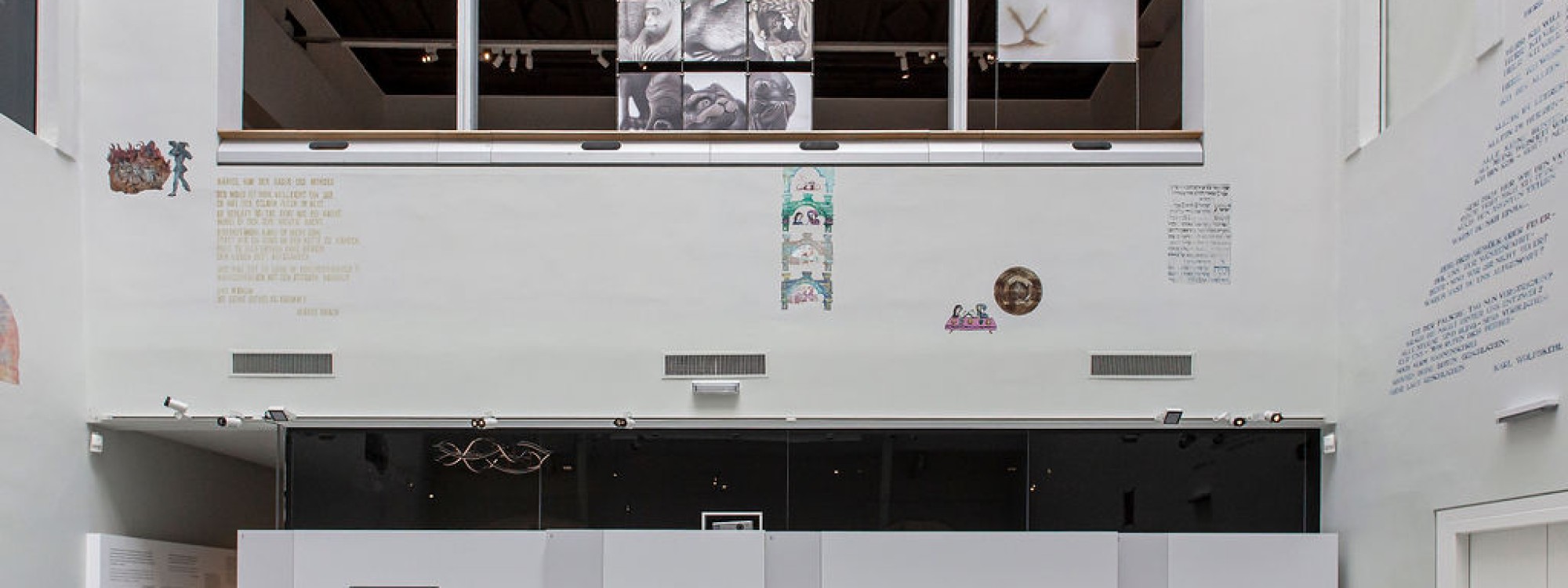
Shabbat is probably the most well-known holiday in the Jewish religion. It is the one day of the week on which, like God who rested on the seventh day, no work is to be done. Following exhibitions devoted to Pesach, Chanukah, Succoth and Rosh Hashanah, the Jewish Museum is now presenting an exhibition on Shabbat, based on six ritual objects of outstanding artistic and historical significance: six bsamim boxes made in Schwäbisch Gmünd in the first half of the eighteenth century, out of a total of eight examples existing in the world. The exhibits come from top-ranking collections (Gross Family Collection, Tel Aviv; Mainfränkisches Museum Würzburg; The Jewish Museum London; Museé National du Moyen Age, Paris; Jüdisches Museum Frankfurt; Det Mosaiske Troessamfund Kopenhagen).
Apart from the bsamim boxes, other ritual objects used during Shabbat, particularly for kiddush and Havdalah, can be seen. They come from the Museum depot and include many objects from the old Jewish Museum in Vienna. The Museum also owns a magnificent bsamim box from Nuremberg, dating from the same period as the objects from Schwäbisch Gmünd. It belonged to the old Jewish Museum.
Heinrich Heine’s poem Prinzessin Sabbath is the most outstanding commemoration of the Shabbat in German literature. This poem forms the framework for the exhibition, which also features audio extracts from the Shabbat service, ritual objects and explanations. The exhibition is designed in the form of a review of the weekly cycle, reflecting the eternal cycle from Shabbat to Shabbat. It starts with the creation, the six workdays, leading up to the Shabbat, the day of rest on which the week’s work can be contemplated.
Curator: Felicitas Heimann-Jelinek
Palais Eskeles
Dorotheergasse 11
1010 Vienna
About the Dignity of Man. The Life and Work of the Artist Ernst Eisenmayer
March 12 to June 16, 2002
. Ernst Eisenmayer was one of the prime movers of the London art scene of the 1960s. His first major exhibition in Vienna at the Secession did not come until 1967. His fate is typical of that of many Austrian Jews. Born in Vienna in 1920, he grew up in modest circumstances and had hardly finished secondary school before the Nazis came to power in Austria. After attempting unsuccessfully to escape over the German-French border, he was arrested and deported to Dachau. With the help of friends he managed at the last moment to obtain a visa for England and emigrated there in 1939. During the war he worked as a toolmaker in a metal factory and was able to paint only in his spare time. While in exile in London he met Oskar Kokoschka, who proved to be a great stimulus for his subsequent artistic development. In 1946/47 he studied at Camberwell School of Art under Victor Passmore.
Eisenmayer’s early pictures show the influence of his life in exile in London: industrial landscapes of London in the 1940s and 1950s, street scenes, London suburbs and some self-portraits. His work was first seen publicly at a joint exhibition of Austrian art in exile organised by the Austrian Women’s Voluntary Workers. In 1945 he put on a further exhibition of Austrian artists, including Kokoschka, in the Young Austria group. Among the acquaintances he met through his Young Austria activities were the artists Georg Eisler, Ernst Deutsch and Heinz Inländer as well as the writer Erich Fried, who had been a fellow pupil at Wasa grammar school in Vienna and who was to remain a friend for life.
Eisenmayer’s early works consisted mostly of aquarelles and oils, but in later years he turned to sculpture, using welded or cast steel, bronze and stone as materials. In the early 1960s he had his first major solo exhibitions in Great Britain and the USA. In 1967 there was an exhibition at the Secession in Vienna, followed two years later by one at Welz Gallery in Salzburg. From 1975 to 1988 Eisenmayer lived near the marble quarries of Carrara in Italy. In 1988 he moved to Amsterdam, and he has lived in Vienna again since 1996. His subject matter is man and his fate and his pictures and sculptures deal with violence, suppression and abuse of power. The exhibition at the Jewish Museum presents a wide range of sculptures, oil paintings and drawings from the various stages in the artist’s oeuvre.
Curator: Gabiele Kohlbauer-Fritz
Palais Eskeles
Dorotheergasse 11
1010 Vienna
Towards the Light of Dawn – Heroes of the Soviet Union
March 12 to June 16, 2002
The Jewish Museum Vienna presents the art installation “Towards the Light of Dawn” by Oz Almog. It resembles his latest two installations (“him too..??” and “Viennese en face”) in style, except that the artist did not paint the portraits himself this time, but uses historical documents of Jewish heroes of the Soviet Union instead.
Almog’s installation deals with the fact that in the Second World War, 1.5 million Jews fought with the Soviet Union and the Allies on the Russian Front, in Europe and Africa, at sea and in the air against the Nazi Germany. There were 500,000 Jews in the Red Army alone, of whom 200,000 died in battle. Thousands of Russian soldiers of Jewish origin showed their courage in the struggle against the German army, and around 160,000 of them received medals and awards for bravery. More than 150 of them received the highest decorations – the Golden Star and the honorary title “Hero of the Soviet Union”. During and after the war, anti-Semites in the Soviet Union would assert that Jews had not fought at the Front but had stayed in the background awaiting its outcome. The 150 or so biographies selected for this exhibition tell a different story.
The artist and curator Oz Almog uses the scant material at his disposal to create a bizarre installation full of pathos, underscored by dramatic lighting and floral decorations typically seen on war memorials. The result is a visual and acoustic panorama that captures the spirit of the time, a “hall of fame”, so to speak, of Jewish heroes.
Curator: Oz Almog
Palais Eskeles
Dorotheergasse 11
1010 Vienna
Persecuting Grandfathers, Interviewing Grandsons? Austrian Gedenkdienst in New York
June 5 to October 13, 2002
“Persecuting Grandfathers, Interviewing Grandsons? Austrian Gedenkdienst in New York” is not only a documentation of the fate of emigrants but also a talking exhibition, which can be seen at the Jewish Museum from 5 June to 13 October 2002. Coinciding with the tenth anniversary of the Gedenkdienst, it deals with a facet of the project organized in co-operation with the Austrian Heritage Collection at the Leo Baeck Institute in New York, namely the Holocaust volunteer service in New York.
Two years ago, a group of young Austrians who had completed their voluntary Holocaust service in New York came to the Jewish Museum with a suggestion for an exhibition. They did so because they wanted to ensure that their work and the work of those who succeeded them in New York would be publicized and made use of in Austria and in New York. The resulting concept is remarkable in many respects. The central theme is one of communication between generations against the background of the terrible events that dominated European history for part of the last century. The exhibition examines the question of how the young generation of 20- to 30-year-old Austrians can communicate with Jews who were driven out of Austria in 1938 and what the kind of results this communication brings. At another level the exhibition also asks whether this approach to history has today become a substitute for communication about this period with the interviewers’ own non-Jewish families.
This question is also relevant when one considers the divergent motives that prompted these young men to do their community service in New York. However, all of them had two things in common: they wanted to help shed light on the history of expulsion, murder and emigration of Jewish Austrians that has always been kept quiet about in the past. And they wanted to work in a city where they could meet living witnesses of that period rather than at a concentration camp memorial.
Gedenkdienst, or Holocaust volunteer service, is a recognized alternative to military service in Austria. Every year the Verein Gedenkdienst sends around 25 young Austrians to Holocaust memorials and related institutions in Europe, America and Israel.
In co-operation with the Leo Baeck Institute, New York.
Curators: Werner Hanak, Christian Prasser, Niko Wahl
Palais Eskeles
Dorotheergasse 11
1010 Vienna
Ernst Epstein. Builder of the Loos House as Architect
June 30 to September 29, 2002
Ernst Epstein, who is known, if at all, as the master builder of the Loos House on Michaelerplatz, erected around 100 buildings in Vienna between 1906 and 1938, many of which were in the tradition of Adolf Loos. He built noble residences and offices as well as villas and industrial objects. The impressive number of structures, the collaboration with Adolf Loos and its influence on Epstein’s architecture prompted the Jewish Museum Vienna to look at his life and, for the first time, to present a review of his work.
This task is rendered all the more difficult by the fact that all documentation from Epstein’s workshop has disappeared and that Epstein never published anything himself. His ideas can be reconstructed in particular by studying his relationship to Adolf Loos and other contemporaries. One important current to be found in his work is the influence of Baroque, Classicism and its pendant Biedermeier. Epstein was guided by the fundamental principles of symmetry, rhythm and harmony. For example, whatever their style, decorative embellishments were logically related to the basic structure of the building. Epstein’s works, most of which are still standing, document a quarter of a century of architecture in Vienna and impressively highlight the shifts from Secessionism to Classicism and from Baroque to Expressionism and New Objectivity (‘Neue Sachlichkeit’).
Epstein’s more than 100 works can be found all over Vienna. By bringing them together for the first time it is possible to obtain an idea of how buildings were constructed in the city between 1906 and 1938, not least as most of them were based on designs by master builders rather than revered architects like Wagner, Hoffmann, Loos or Frank. An insight into the work of a good master builder like Ernst Epstein puts into perspective the achievements of these star architects, whose names have become synonymous with Viennese architecture at the turn of the 20th century and between the wars, and helps us, perhaps for the first time, to really appreciate them. Information about buildings that are often dismissed by historians as ‘anonymous architecture’ also helps us to flesh out the skeleton formed by the few structures that have come to be recognised as veritable masterpieces.
Curator: Markus Kristan
Palais Eskeles
Dorotheergasse 11
1010 Vienna
The World of Jewish Postcards
June 30 to September 29, 2002
Picture postcards experienced a boom around the turn of the century not only as a means of fast communication but also as collectors’ items. Writing and exchanging postcards quickly became a popular hobby. Apart from postcards showing famous sights and views of towns or countryside, the great demand gave rise to wide-ranging series dealing with special topics. One of these was Judaica postcards, interesting above all for Jewish addressees.
The postcards shown here, compiled from public and private collections in Europe and Israel, range from views of synagogues and pictures of Jewish customs to portraits of famous personalities, cards sent from the Front by Jewish soldiers during the First World War and Zionist themes. The picture postcards presented in small “plastiscopes” provide an insight into a little-known area of postcard production at the turn of the century and also offer a fascinating, half-realistic, half-idealized view of a lost world.
A exhibition by the Jewish Museum of Franconia in Fürth.
Curator: Bernhard Purin
Palais Eskeles
Dorotheergasse 11
1010 Vienna
Music and Poetry. Manuscripts from the Collections of Stefan Zweig and Martin Bodmer
October 23, 2002 to January 6, 2003
The Jewish Museum Vienna is presenting an exhibition of valuable autograph manuscripts, many of which come originally from the collection compiled by Stefan Zweig, which today forms part of a large private collection owned by Martin Bodmer Foundation in Coligny near Geneva. Before the manuscripts, written by over 50 of the most prominent personalities in the history of European thought and music, are returned to the Foundation’s new museum in Switzerland, they are being shown in Austria: first in Salzburg, and now at the Jewish Museum in Vienna. At the latter venue, a number of portraits and outstanding Hebraica have been added.
The manuscripts are divided into the following categories: Lieder (Beethoven, Alban Berg, Debussy, Mendelssohn, Schönberg, Schumann, Schubert, Tchaikovsky, von Webern); opera and oratorios (Bizet, Liszt, Puccini, Scarlatti, Richard Strauss, Wagner); and drama, poetry and prose (Balzac, Freud, Goethe, Hölderlin, von Hofmannsthal, Nestroy, Nietzsche, Rolland, Schiller, Trakl, Zweig). One of the additional highlights is a short speech made by Napoleon to his soldiers. The exhibition also includes portraits of figures such as Brahms, Debussy, Grillparzer, Mahler, Rousseau and Hugo Wolf, together with a small section on instrumental music with works by Beethoven, Bruckner, Donizetti and Mahler, as well one devoted exclusively to Mozart.
Among the Hebrew manuscripts, which were not shown previously at the Carolino Augusteum Museum in Salzburg, is a selection of unusual Hebraica, which has astounded even the most inveterate scholars of Judaism: for example, there is a terracotta bowl from Nippur with a magic Jewish inscription in Aramaic-Syrian dating from the year 500, and a Pesach haggadah written and illustrated by Joel ben Simeon for a German-speaking community in Italy around 1470. There are also Latin manuscripts on parchment with texts by Josephus Flavius from the 9th century, and extremely rare 16th and 17th century prints of the works of Moses Maimonides, the Jewish scholar from Cordoba, including the Mishnah Torah in Arabic using the Hebrew alphabet with a Latin translation.
Curators: Bibliotheca Bodmeriana, Carolino Augusteum Salzburg, Felicitas Heimann-Jelinek
Palais Eskeles
Dorotheergasse 11
1010 Vienna