Black–Jewish Alliances Between Solidarity and Antisemitism
Alliances in the struggle against racism and discrimination between African Americans and Jewish Americans in the United States look back on a long and complex history. Their collaboration reached its peak during the Civil Rights Movement of the 1960s. African Americans and Jewish Americans took to the streets together to fight against the systemic racism embedded in U.S. society. Thousands of Jews joined protest marches and rallies and participated in the so‑called Freedom Rides.¹ Symbolic of this flourishing cooperation are, among other things, the photographs of Martin Luther King Jr. and Rabbi Abraham Joshua Heschel, arm in arm during the 1965 march from Selma to Montgomery.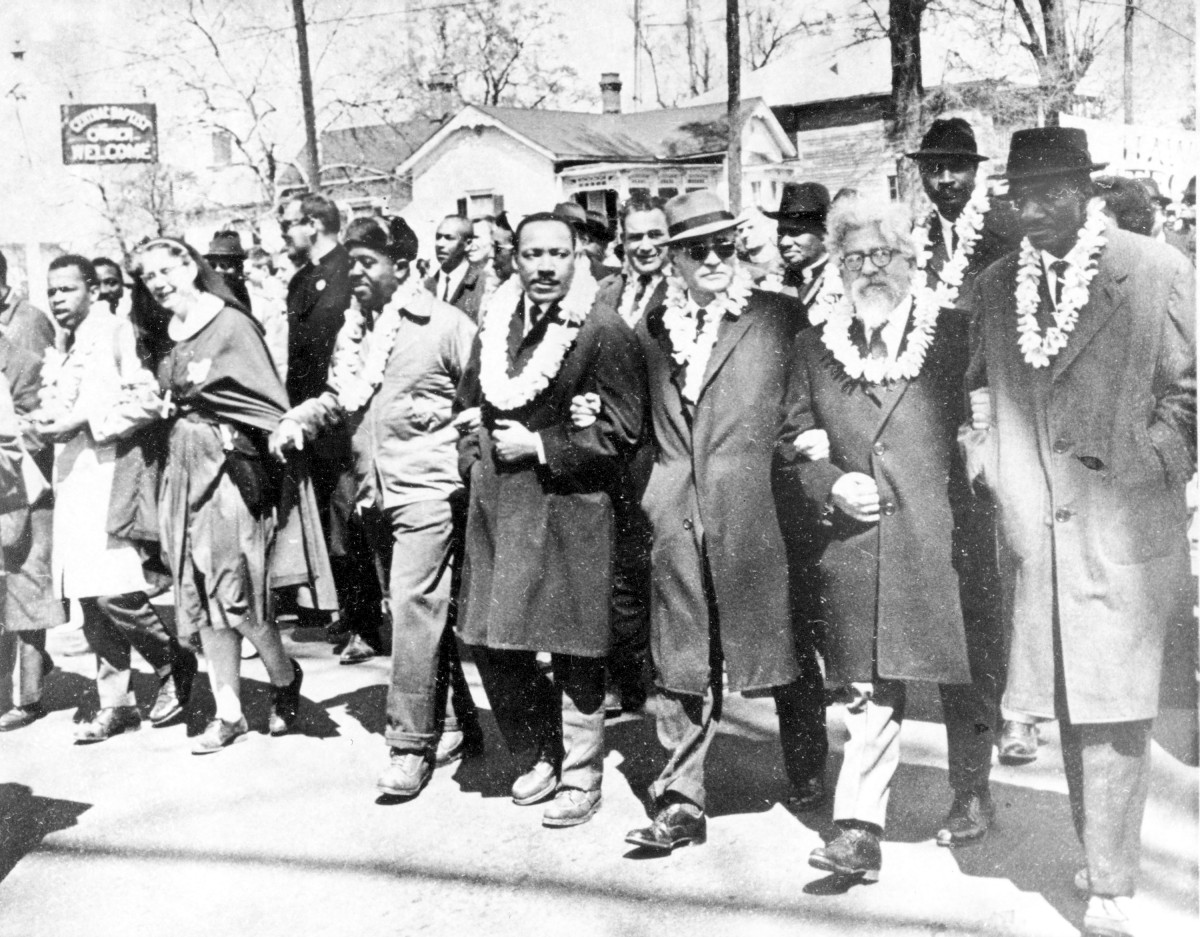
© AP1965 AP picturedesk.com
Despite the extensive collaboration, economic and racial tensions had existed from the very beginning and ultimately led to the fragmentation of the civil rights coalition by the 1970s at the latest. Especially after the Six-Day War of 1967 in Israel, solidarity with the Palestinians became part of the political platform of militant African American groups such as the Black Panthers or the Nation of Islam. This shift was accompanied by a devaluation of earlier Black–Jewish alliances as well as by antisemitic and anti-Zionist hostilities. On the Jewish side, the same period saw the emergence of right‑wing extremist and racist organizations such as the Jewish Defense League, whose following grew steadily as well.² In the decades after the civil rights movement, relations between African Americans and Jewish Americans were thus often marked by tension, antisemitism, and racism.
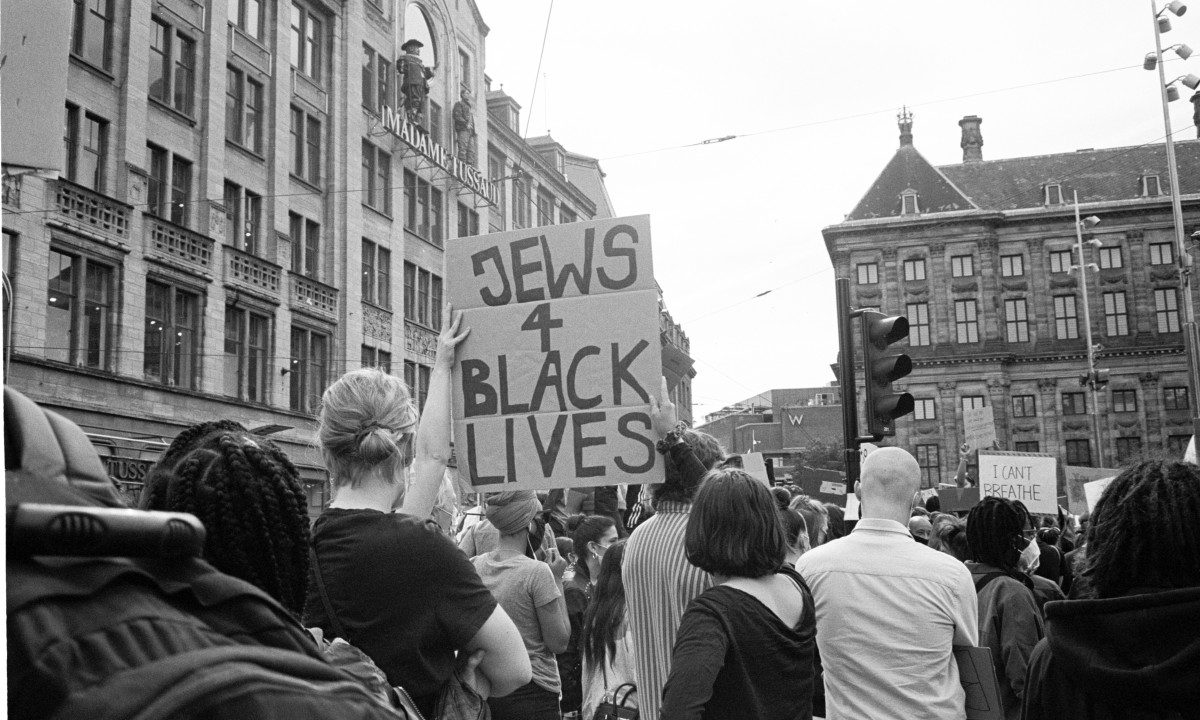
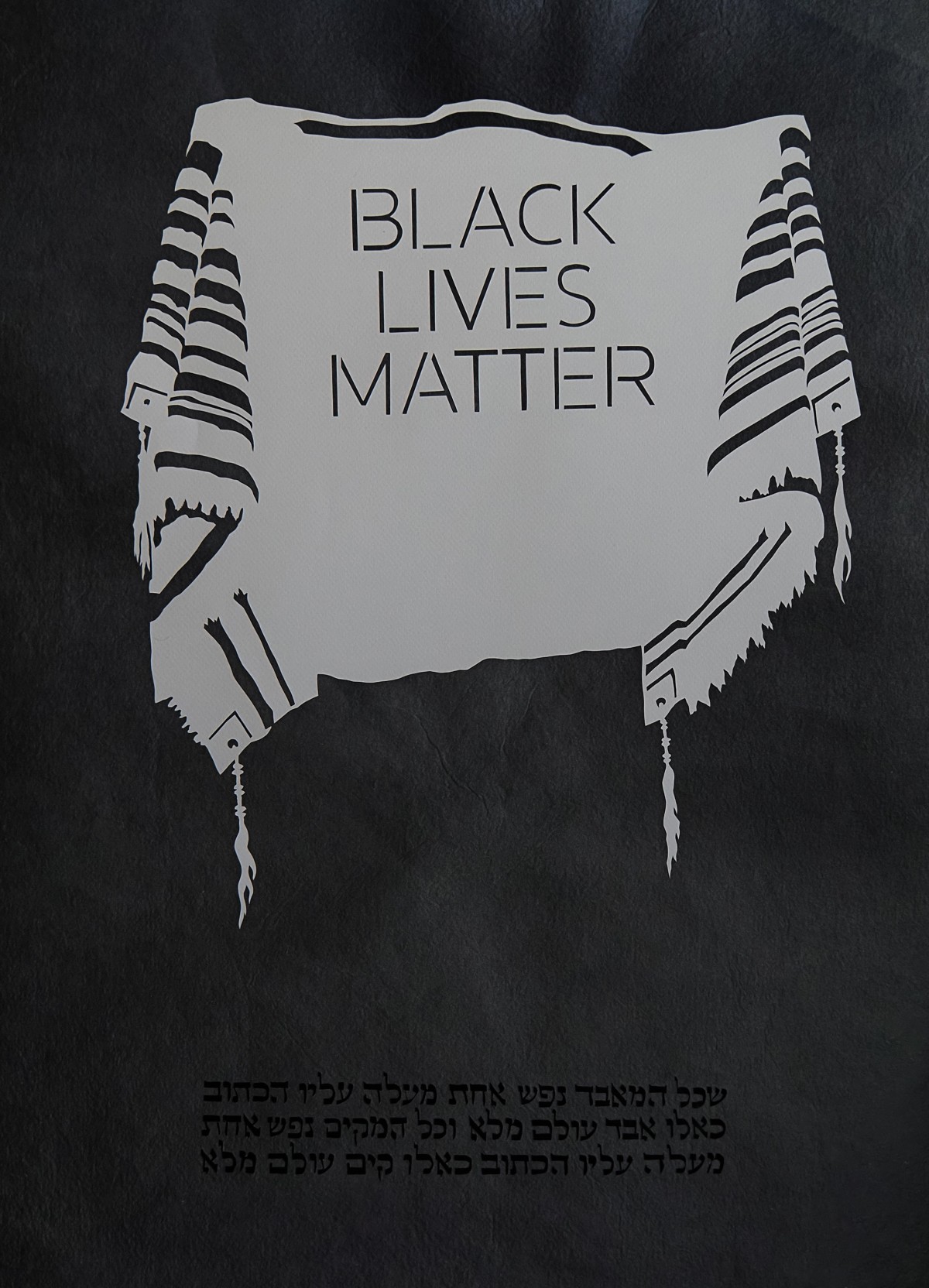
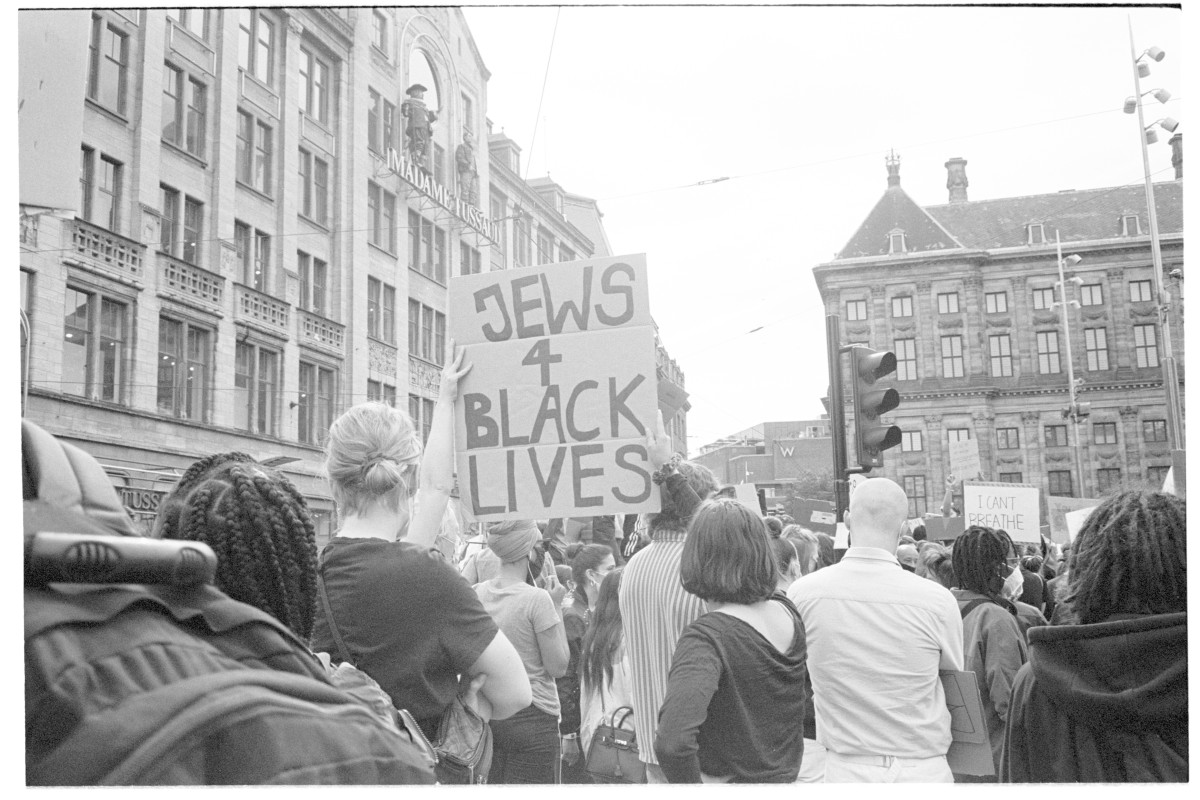
With the rise of the Black Lives Matter movement in 2013, many viewed the moment as an opportunity to revive the Black–Jewish cooperation of the civil rights era. After George Zimmerman was acquitted in 2013 of the charge of killing unarmed African American teenager Trayvon Martin, a group of activists responded on social media with the hashtag #BlackLivesMatter. The online movement soon expanded into real‑world protests and a wide network of local groups. The death of Michael Brown, who was shot by a police officer in Ferguson, Missouri, in 2014, led to nationwide demonstrations and to the consolidation of the Black Lives Matter movement. From the outset, numerous Jewish groups, communities, and activists expressed solidarity and saw their engagement as a continuation of the civil rights coalition - many of them under the slogan “Jews 4 Black Lives.”
© Nienke Fonk (1987). Collection Joods Museum, Amsterdam
Following the murder of George Floyd in 2020, also in Minnesota, the Black Lives Matter movement received international attention, and protests spread to other countries. At this point, Aaron Silver’s artwork gained wider visibility, was reproduced many times, and was displayed, for example, as a poster in synagogues and Jewish institutions as a sign of support. In August 2020, a statement of solidarity with Black Lives Matter, signed by 600 Jewish organizations, appeared in The New York Times.
However, the broad support for the movement among Jews represents only one side of the picture. Many Jews and Jewish organizations regard Black Lives Matter, and Jewish support for it with deep skepticism, pointing to antisemitic and anti‑Israel positions rooted in strands of African American activism dating back to the 1970s, elements of which persist in parts of the Black Lives Matter movement today. After the attack on Israel by the terrorist organization Hamas on October 7, 2023, and the subsequent war in Gaza, these tendencies within the movement became all the more visible.³ Jews have been excluded from the broader struggle against discrimination, their experiences with antisemitism and racism dismissed, and they have been indiscriminately labeled as “white colonizers.” Notably, this places Black Jews and Jews of Color, who identify with both communities - in an especially difficult position.
Black–Jewish alliances have existed in a state of ongoing tension since the end of the civil rights era. On the one hand, they are shaped by solidarity and a shared history of fighting discrimination; on the other, they remain marked by debates surrounding Israel, by antisemitism, and by mutual hostilities. Despite these tensions, the civil rights movement and the Black Lives Matter movement alike demonstrate the importance and potential effectiveness of intersectional alliances.1 See Cheryl Greenberg, Allies in the Fight Against Hate? Black–Jewish Coalitions Since the Civil Rights Movement, in: Tom Juncker, Daniela Pscheiden, Hannes Sulzenbacher (eds.), Black Jews, White Jews? On Skin Color and Prejudice, catalogue to the exhibition of the same name at the Jewish Museum Vienna, Göttingen 2025, pp. 238–244.
2 See Christian Voller, Gangs of New York: Jews and Blacks in the United States, in: Juncker, Pscheiden, Sulzenbacher (eds.), Black Jews, White Jews?, pp. 245–251; Eunice G. Pollack, The Black Lives Matter Movement, Jewish Allies, and the Long Legacy of Black Anti‑Zionism, in: Antisemitism Studies, Volume 8, Number 2, Fall 2024, pp. 195–254.
3 See Pollack, pp. 195–254.