Jewish history has always been inextricably linked to migration. Legal restrictions and economic constraints led to a high degree of mobility within the Jewish population, while many were also forced to build new lives elsewhere because of expulsions, antisemitic legislation, or violence.
In 1867, the Jews of Austria-Hungary attained civil equality. This new freedom of movement prompted many Jews to leave the more remote regions of the monarchy for the capital and imperial city of Vienna. Wholesale traders and peddlers had to undertake extensive journeys. Women were married off to often far‑away places; some young people were sent elsewhere for their education, while others left the confines of their family environments and struck out on their own.
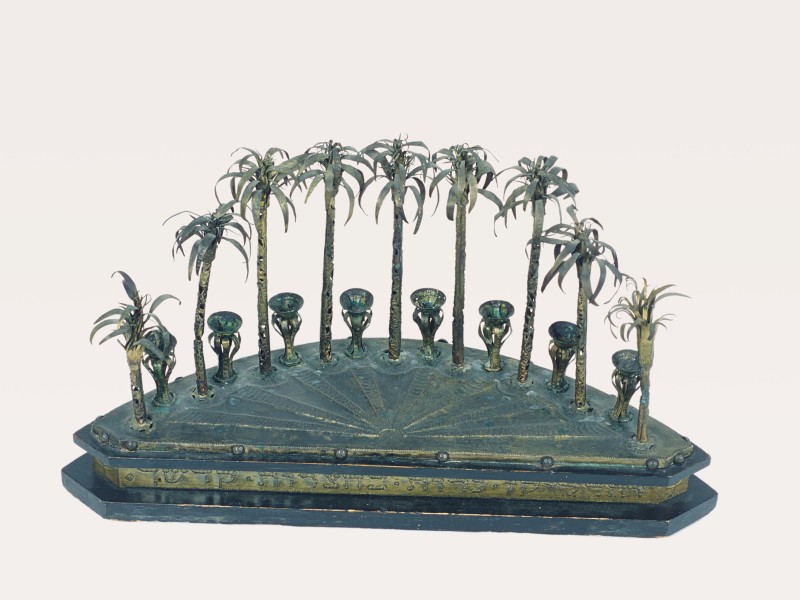
In this way, objects too migrated across the world or were created by Jewish immigrants themselves. These objects are the protagonists of this exhibition.
A large part of the Judaica collection of the Jewish Museum Vienna is connected to the destruction of Viennese Jewry by the National Socialists. Many of the objects were recovered from the ruins of Vienna’s synagogues after the November Pogrom of 1938. They bear witness to the displacement and murder of their owners, but sometimes to the rich life that came before as well.
Viewing these objects from different perspectives makes clear that the collection resembles a kaleidoscope in which (Jewish) world history is reflected in many different ways. From Ukraine, Denmark, and Italy to India, Vietnam, and the United States, stories of migration are embedded in them.